Showing posts with label loopholes. Show all posts

Monday, June 4, 2012

What else can be done about exemptions in Washington State


In a previous post I touched on the number of tax exemptions  and the impact they have on our state’s budget.  I also mentioned some of the complications that arise when trying to close exemptions.  With the increasing number of exemptions on the books and the limitations on the legislature’s ability to close those exemptions, the big question remains: what can be done to mitigate the impact of these exemptions in Washington State?
One interesting proposal, introduced during the 2012 Legislative Session, came in the form of HB 2530, introduced by Seattle Democrat Rep. Reuven Carlyle.  This bill, if passed, would have placed a mandatory sunset (expiration) date for all newly established exemptions.  Every 10 years an exemption would expire if not reviewed and extended by the legislature.  This would require the legislature to review an exemption and take deliberate action to extend that exemption if deemed necessary. 

This legislative proposal was a breath of fresh air in the exemptions debate.  So much of the debate has been characterized by extremes—one side calling for the closure of exemptions and the other refusing to consider any changes to the list of exemptions.  This proposal sits right in the middle by calling for a regular review that is based on sound economic principles, a review that is automatically triggered by a sunset.  This trigger would not be avoidable and would require careful consideration no matter how unpopular that discussion may be. 
Unfortunately, the legislation did not pass into law, but it did garner some media attention and added another facet to the tax reform debate in Washington.  Both Rep. Reuven Carlyle and Rep. Chris Reykdal spoke about this debate on an episode of TVW’s inside Olympia.  (click here for full video). This proposal addressed long term reform and, as written, would not provide immediate relief for Washington’s budget woes.  In this respect, this proposal is doubly refreshing in that it addresses larger long term systemic problems in our tax code.  In tough economic times, it is easy to become consumed with immediate action that provides instant relief.
The problems with Washington’s revenue system spans decades.  An undue obsession with short term solutions only compounds the problem by leaving the larger system failures in place.  If we do not take the lessons learned from the Great Recession to heart by addressing the larger systemic problems in our tax code, we are kicking the can of reform onto the coming generations which may be hit harder by future recessions.  Short term steps must be taken, but long term reform (like that introduced by HB 2530) is necessary.

Friday, June 1, 2012

Exactly how do you close tax exemptions in Washington State?


There has been increased discussion in the halls of our capitol about the impact tax exemptions have on our state.  Previously, I talked in detail about just how much exemptions are costing our state and how many we have on the books.  Many have argued that it’s time to close some of those exemptions, or at least bring them under review.  Unfortunately, closing an exemption is more complicated that you might think.
The authority to levy a tax is clearly given in Article VII of Washington’s Constitution, which is aptly named Revenue and Taxation.  The complexities of this article and the authority given have been the subject of numerous debates and countless courts cases.  The debates have played out in the legislature, the Supreme Court, and the ballot.  To say that it is complicated is, well, an understatement.  However, its relevance is paramount in trying to understand just how to address the issue of exemptions.
To put it plainly, the Federal Government and the Washington State Legislature have the authority to manage our tax system, including modifying any existing exemptions.

However, a recent ballot initiative has impacted the legislature’s ability to manage Washington’s revenue system.  Initiative 1053 (led by initiative activist Tim Eyman) passed in November 2010 with over 63% voter approval.  This initiative re-instated a 2/3rds vote requirement in both houses of the Washington State Legislature to make any changes to our tax code.  This requirement was first introduced by I-601 in 1993 and was later reinstated by I-695 in 1999 and again by I-960 in 2007.  The 2/3rds requirement INCLUDES the closure of tax exemptions because it would require legislative action that would amend our tax code resulting in a net increase in revenue. 
The super-majority requirement has plagued reform advocates since it was first introduced.  There have been a number of attempts to mitigate the impact of these initiatives, including the introduction of a temporary increase in sales tax on certain retail items to a full legal challenge of I-1053 which is currently being reviewed by King County Superior Court.  The outcome of the legal challenge will have a big impact on the legislature’s ability to address or modify existing exemptions.  Until then, it’s going to take a supermajority in the legislature to close any of the 452 revenue generating tax exemptions.

BUT, there is another way.  The ballot.  Both I-960 and its predecessor I-1053 reinforce the power of the ballot by reinforcing the people’s right to petition their government.  An existing exemption could be closed by a simple majority vote of the people.  However, it’s important to realize just how difficult it can be to pass an initiative in Washington State.  To date, nearly 1,200 initiatives have been introduced and only 69 have successfully passed into law.
Bearing in mind the complications associated with the closure of tax exemptions, reform advocates should remain diligent in their efforts to bolster fairness in our tax code through the elimination of some outmoded exemptions.  However, the road to closure for tax exemptions is wrought with pitfalls and speed bumps.  When trying to address the fiscal crisis other more short term measures should be explored as well.  Those might include the introduction of mandatory reviews and sunsets of existing exemptions or greater scrutiny of any newly proposed or existing exemptions.  These are two options that are being explored which I will discuss in another post.

Thursday, May 31, 2012

Property Tax 101: Exemptions, Credits, & Deductions

Part 2

In Part 1 of our discussion on property tax exemptions, credits, and deductions we touched on a higher-lever overview.  Today, we dive into a few of the more popular programs in the state.
A majority of the exemptions mentioned in Part 1 are targeted at organizations or entities that serve the public and add to the public good.  There are also a few exemption and deferral programs aimed at relieving the tax burden on certain groups of people.

Senior citizens/disabled persons can apply for an exemption if they are 61 years old or retired due to a disability and whose household income is $35,000 or less.  This exemption program, which was passed as a constitutional amendment in 1966, is a large one in the state.  According to the Department of Revenue, in 2009 (the most recent data available) $176.1 million in property tax relief was given to homeowners, which equates to an average savings of $1,555 per household – that’s no nominal figure! 


A related program for senior citizens/disabled persons is not an exemption program but a deferral program.  Under this program, seniors 60 years or older in a household that has less than $40,000 of disposable income can defer property tax collections until the property ceases to be the permanent residence  of the homeowner or surviving spouse.  The deferral then becomes a lien on the residence and is repaid from the proceeds of the estate.  In the meantime, the state reimburses local jurisdictions for lost revenue.  This deferral program isn’t as widely utilized as the exemption program.  In 2007, only 950 households took part in the program, compared to the just under 114,000 households that took part in the exemption program.
In 2005, a similar program was established for widows/widowers of veterans who died in the line of active duty.  In 2007, the legislature created a new deferral program for low-income households.  Those households with a combined income of $57,000 or less can qualify for the deferral program which allows taxpayers to defer half of their yearly property taxes; payment on the second half is then postponed until the residence is sold.

It is clear to see what the legislature’s priorities have been by looking at the history of property tax exemptions and deferral programs.  Those most vulnerable to losing their homes – seniors, low-income, and widows/widowers – are considered entitled to state assistance.  Do you agree with the legislature’s view?  Should we be subsidizing those in need?  Around the same time these popular programs were put into place, a Tim Eyman initiative (I-747) was voted into law, which restricted property tax valuations to 1% per year.  Clearly, Washington State residents were struggling with the cost of their property taxes and the legislature made an effort to help those most in need.

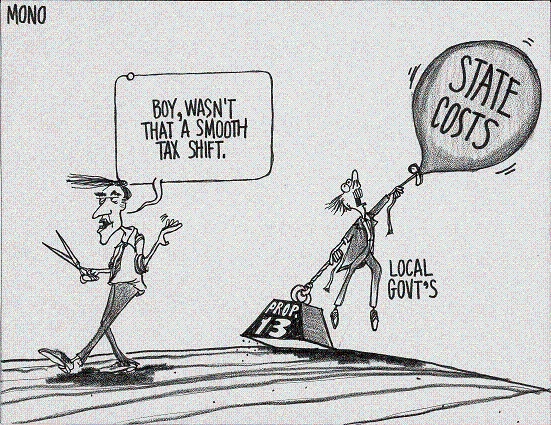
What exactly is a tax shift?

The term tax shift isn’t one that’s very complex or hard to understand.  However, it is used in various forms, all with different meanings.  Some refer to a tax shift as the transfer of some or all of a tax burden from one entity to another.  For example, shifting a tax burden from state government to local government.


At its most basic level, a tax shift occurs when an exemption is put into place.  For example, as discussed in the 2012 Legislative Guide to Washington State Property Taxes, the senior citizen’s property tax exemption has the effect of, “slightly increasing the tax rate that owners of all other taxable property must pay by reducing the overall base of taxable property” (pg. 5).  In other words, one segment of taxpayers’ taxes are increased as a direct result of the exemptions afforded to others.
Of course there are many reasons to offer exemptions for people and businesses that benefit society as a whole.  Small business, seniors, and disabled populations are just a few groups that the legislature has deemed deserving of exemptions and most Washingtonians would agree that helping these vital groups benefit us all. 
However, as detailed in a previous post on the cost of exemptions in Washington State, there are 640 tax exemptions.  Of those, 452 would likely generate revenue if eliminated.  I’m not going to suggest that all of those exemptions should be repealed.  I see exemptions as playing a vital role in how our economic systems work.  Some tax exemptions stimulate growth in the economy and help small businesses survive.  Nevertheless, by leaving as many exemptions as we have in place, the tax burden is shifted to those most vulnerable in the state – mainly through the sales tax.  Certain exemptions have been on the books for decades and their relevance has certainly expired long ago.  To have a working tax system we need to be constantly looking at why our system is in place – not just do as we’ve always done.  In order to reform our tax system there needs to be thoughtful examination of our current exemptions combined with major alternatives to our reliance on the volatile sales and property taxes.  In doing so, the tax shifts currently burdening our most vulnerable populations could be minimized which will ultimately help the overall economy of the state.

Monday, May 28, 2012

Tax Discussion Definitions: Elasticity


In order to have a better understanding of all the nuances of discussing tax policy, I’m going to spend some time talking about terms that policy wonks and lawmakers throw around a lot. This entry will focus on the concept of elasticity; if you’re an economist this might be old news but a refresher never hurts right?


So what is elasticity?  Basically, elasticity is a measure of responsiveness. It tells how much one thing changes when you change something else that affects it.  Best analogy is a rubber band; it’s elastic when it stretches in response to you pulling it.  In economics, there is elastic demand—this happens when a consumer buys less of something when the price increases and more of something when the price drops.  There’s also inelastic demand, which occurs when a consumer buys about the same amount if the price goes up or down. Dr. Samuel Baker from the University of South Carolina created an interactive tool that provides more examples of this concept. The first example he provides is about a bleeding unconscious man that’s brought to an emergency room.  This would be considered inelastic since he’ll get treatment regardless of the price.

So what does this have to do with tax policy?  Lawmakers always have to consider how much of a burden they’re imposing when raising taxes and know who actually ends up paying for a tax that might be aimed a different group (example: buyer vs. seller).  This concept is know as tax incidence

If a tax is raised too much, use of the taxed service or product could decrease below the expected level of tax revenue a government is aiming to collect.  Also, politicians need to be aware of how the public will react to certain taxes.  For example, food is pretty inelastic since we need it to survive. If groceries were taxed in Washington, consumption might decrease some but the tax will be paid due to the necessity of eating. This would be a burden on families, especially those with lower incomes (Link to Catherine’s food brief)

Also, policymakers use the concept of elasticity to reduce certain behaviors. The best example of this is tobacco (link to Catherine’s tobacco brief) It’s commonly known that the long-term effects of smoking and chewing tobacco physically harm and kill people.  This makes tobacco an easy target in terms of raising taxes. To change consumption behavior, lawmakers raise the tax to try and make smoking too expensive for consumers.  When this happens,  revenue from the tax declines and it’s easy for the Legislature to argue in favor of the declining revenue of tobacco sales because the decreased use offsets future healthcare costs.  As Catherine mentioned, the State recently closed a loophole for consumers when they raised the fee for roll-your-own cigarettes.

That’s elasticity in a nutshell!  Without using mathematical models to describe pricing points and such, just know that elasticity is how you react to certain things like cost and how flexible you are when market variables change.  This is a relationship that government needs to understand well if it wants to implement tax policies that are a) fair to the majority of citizens, and b) politically possible.   We’ll add more definitions like this one to give you a clearer perspective of underlying issues that come up when folks talk about taxes.

Tuesday, May 15, 2012

What exactly is a tax loop hole anyway?

With so much heated rhetoric surrounding loopholes and the impact that they might be having on our tax code, it would be useful to spend some time getting at the heart of what a loophole, exemption, tax giveaway, or whatever you want to call it is.  For my purpose, I call it an exemption. However, a clear understanding in this department might make for more informed debate about the future of exemptions in Washington State. 

To date, there are 640 exemptions on the books in Washington.  Of those, 452 would likely increase revenue collections for core public programs if eliminated.  These exemptions can be found throughout the Revised Code of Washington (RCW).  The majority can be found in Title 82 and Title 84 of the RCW. 
Washington’s tax code has become riddled with exemptions.  So much so that in order to keep track of these exemptions and their complexity a full report must be written every 4 years by the state’s Department of Revenue detailing the presence of exemptions in our tax code.

These exemptions stand as a testament to our state’s changing culture and economy.  For example, RCW 84.39.010 provides for a property tax exemption for widows and widowers of U.S. Veterans. Another example is RCW 82.48.100, which provides an excise exemption for aircraft under specific circumstances. The list continues to a sum of 640 exemptions--452 of which would generate revenue if eliminated. 

After spending time with the list of exemptions, it becomes clear that this list is indicative of communal priorities.  Behind each of these exemptions, there was an influential voice that saw value in adding a specific exemption to our tax code.  A cynic would argue that these exemptions are the legacy of effective lobbying and special interest groups that cater to big business in the state.  An optimist would argue that these exemptions reflect the majority will of the tax paying public and were established through careful conversation and exploration.  Regardless of your perspective, it is hard to ignore the implicit values behind each of the 640 exemptions.

The property tax exemption for widowed spouses of veterans is a good reflection of a community that looks to honor and protect those that served.  The aircraft exemption is indicative of a set of priorities that includes the importance of business and ensuring that our state retains its competitive edge.  
Exemptions and their impact on our states revenue collections have battled with government efficiency for the center stage spot light during this recession in Washington State.  The exemptions debate has played out in the legislature, the courts, and the public through the initiative process.  Before entering into a tax reform discussion, background orientation will not only better inform debate, but may illuminate avenues for coping with future economic downturns.